
First five minutes
Digr is one shared planet: eight volcanic islands joined by warm mud, and everyone online on the same chain.
- You arrive on Mosswake with the old pickaxe. No account, wallet or purchase is needed.
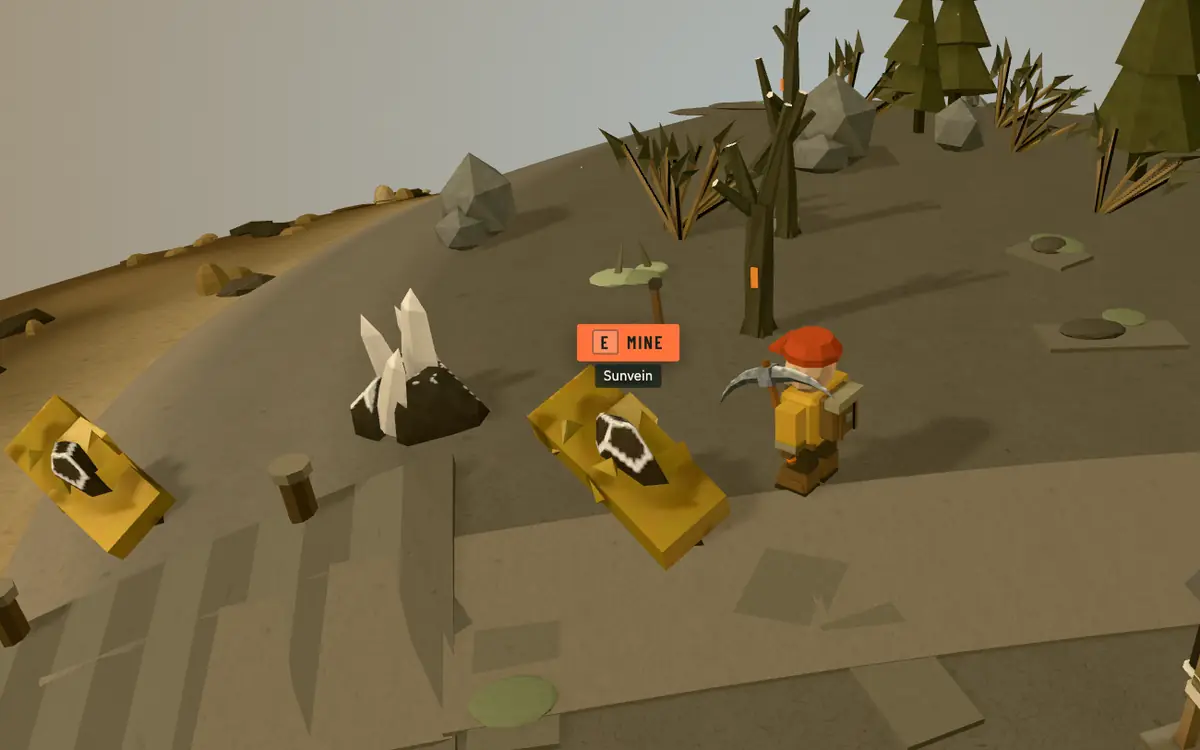
- Walk out to a claim and up to an ore node. When the E MINE prompt appears, press it (or tap the node).
- Swing at the ore. Aim for the shiny spot, marked with a star: it counts for more, so the ore comes free sooner.
- The node gives up a mineral. It goes into your journal and onto a pedestal in your museum, and pays sparks, the game’s currency.
- Spend sparks at Mara’s market, climb to the next tool, and take a buggy to the islands further out.
Real-asset rewards Live
Some finds pay real tokenized assets on Robinhood Chain, straight to your own wallet. Bring up a gold nugget and you earn GLD, tokenized SPDR Gold Trust.
Playing is free and earning is free. Claiming what you earned needs a small $DIGR hold and burns some $DIGR, both explained below. Every amount on this page is a cap, not a promise.
What you can earn
Each reward is tied to one mineral, and every one pays from the first pickaxe. You only need to be on the right island, at the right kind of node.
| Find | Pays | Where | Status |
|---|---|---|---|
| Gold nugget | GLD, SPDR Gold Trust | Sunvein nodes on every island, from the first pickaxe | Live now |
| Any other find | cbBTC, Coinbase Wrapped BTC | A rare 0.3% roll on digs whose mineral pays no asset | Live now, holder tier only |
| Tar pearl | USO, United States Oil Fund | Seep nodes on Emberhollow | Live now |
| Native silver | SLV, iShares Silver Trust | Silverback nodes on Obsidian Reach and Pyrecrown | Live now |
| Monazite | USAR, USA Rare Earth | Emberstone nodes on Pyrecrown | Live now |
CLSK (CleanSpark) is not paid for finds. It is planned as a mining tournament prize later; it is not wired up yet, and tournaments pay sparks only today.
How to start earning
- Play. Open Digr in your browser and start mining. No wallet is needed to play.
- Make a free explorer account (Account in the game) and bring up 50 lifetime finds. There is no waiting period: once you pass the steps, you earn from your next dig.
- Link a wallet. Tap your sparks to open the rewards panel and choose Link a wallet. Linking only signs a message: no transaction, no token approval.
- Dig. Every dig that starts after that can pay. Digs mined by hand, with steady hands or with auto-mine all count. Rewards collect in your balance, up to your daily limit.
- Claim. When you want the tokens, claim them from the rewards panel to your linked wallet (see Claiming).
The rewards panel always shows the steps you still have, including how many finds you need.
Your first reward is guaranteed. If you have never earned one, a GLD reward lands within your first 50 digs that can pay (the panel shows your count). Your mineral never changes, and after your first reward the normal odds apply.
Free and holder tiers
Your tier is decided when a dig starts. Hold $25 or more of $DIGR in the linked wallet and the dig earns at the holder tier; otherwise it earns at the free tier.
| Free tier | Holder tier | |
|---|---|---|
| Who | Anyone who passed the steps above | $25 or more of $DIGR in the linked wallet |
| Each reward | $0.05 | $0.05 up to the asset’s cap: GLD $1, SLV $0.50, USO $0.25, USAR $0.50, cbBTC $2. Small amounts are common, the cap is rare. |
| Daily limit per wallet | $3 | $25 at kit tier 1, rising with your kit: $30 at tier 3, $40 at tier 4, $60 at tier 8, $100 at tier 16 |
| cbBTC roll | No | 0.3% on digs whose mineral pays no asset |
Amounts are set in US dollars and converted to tokens at the live price feed when the dig starts. Daily limits reset at 00:00 UTC.
Claiming
- Hold to claim. The linked wallet must hold at least $25 of $DIGR, continuously for 1 hour, before a claim. This applies to free-tier rewards too.
- Burn. Each claim burns 7,500 $DIGR from your wallet, sent to the burn address. If anything interrupts after the burn, it stays attached to that claim and is never charged twice.
- Two wallet steps: first the burn, then the claim itself. You pay the small network fee (gas) on Robinhood Chain for both.
- A claim covers one asset, up to about $3 of it. Larger balances take more than one claim, and there are at most 6 claims an hour.
- The tokens are real tokenized assets, sent on chain to your wallet by Digr’s reward contract. Each claim links to its transaction on the Robinhood Chain explorer.
Limits and the shared pool
- A shared daily pool. All rewards across all players come out of one daily pool that resets at 00:00 UTC. When it is used up, rewards rest until the reset; your digs keep finding minerals and sparks as usual.
- Per-asset room. Each asset also has its own daily room. An asset whose room is full, or whose price feed is stale, sits out until it is available again.
- Pace. Rewards arm for up to 360 digs an hour per player; past that they pause within the hour.
- One person, one earner. At most three earning players per network a day. Very high earnings in one day, or play that looks machine-driven (see fair play), open a short review. Rewards earned stay saved during a review.
Fair by design
The mineral and every reward roll come from the dig’s committed seed, sealed before your first swing. Spark-strike skill changes carats and bonus sparks only, never what a dig pays. Each dig records its reward rules, prices and caps, so a later rule change never touches a dig already under way.
$DIGR
$DIGR is Digr’s own token, and it is live on Robinhood Chain. The homepage shows its one official contract address, with copy, explorer and trade links. Only that address is ours; any other $DIGR address is not us.
Where you live matters
There is no country block. Stock-token rewards (GLD, SLV, USO, USAR) are Robinhood Stock Tokens. They are not offered to US persons and are restricted in Canada, the UK, Switzerland and the UAE. You can still claim them, but you may not be able to trade or swap them where you live. Claiming is your own responsibility. cbBTC is not a stock token.
Reward questions
Why didn’t my find pay? Only the four reward minerals (gold nugget, tar pearl, native silver, monazite) pay an asset, plus the rare cbBTC roll for holders on other finds. If a reward mineral paid nothing, check the rewards panel: a step may be missing (account, 50 finds, linked wallet), your daily limit may be reached, or the shared pool may be resting until 00:00 UTC. A wallet linked mid-dig counts from your next dig.
Why was my reward only $0.05? That is the free tier. Hold $25 of $DIGR in the linked wallet and your next digs earn at the holder tier.
How do I claim? Tap your sparks, open the rewards panel and press Claim on the asset. Your wallet asks twice: the $DIGR burn, then the claim.
What is burned? 7,500 $DIGR per claim, sent from your wallet to the burn address. Nothing else is taken from your rewards.
Which network? Robinhood Chain. Rewards, $DIGR and claims all live there.
Who pays gas? You do, from the linked wallet. Network fees on Robinhood Chain are small.
Nothing here is financial advice.
Controls
| Input | What it does |
|---|---|
| W A S D or arrows | Walk |
| Left click | Walk to that spot |
| Right or middle drag, scroll wheel | Turn the camera, zoom |
| E | Mine the node in reach. Near Mara it opens the market, near your museum the museum. |
| F | Start mining. With no node in reach, it walks you to the nearest one. |
| B | Board or park a buggy |
| M J L | Market, journal, standings |
| H | Wave |
| Enter | World radio |
| V R | Planet view, camera reset |
| Esc | Close a panel or the radio |
On a phone: the thumbstick walks, dragging the scene looks around and pinching zooms. Tap a node or the big MINE button, then tap the ore; the mining panel sits in reach of one thumb.
Ore nodes
Every claim holds a few ore nodes: chunky rocks studded with crystals. The crystal colour and shape tell you the node’s family, never which mineral is inside or how rare it is. The server spawns them, so everyone sees the same nodes in the same places.
Claims near Mosswake hold three live nodes, the middle of the chain four, the far end five (fewer where a claim is small). You reach a node from about two paces away, and nodes are solid: you walk around them, and so does a buggy.
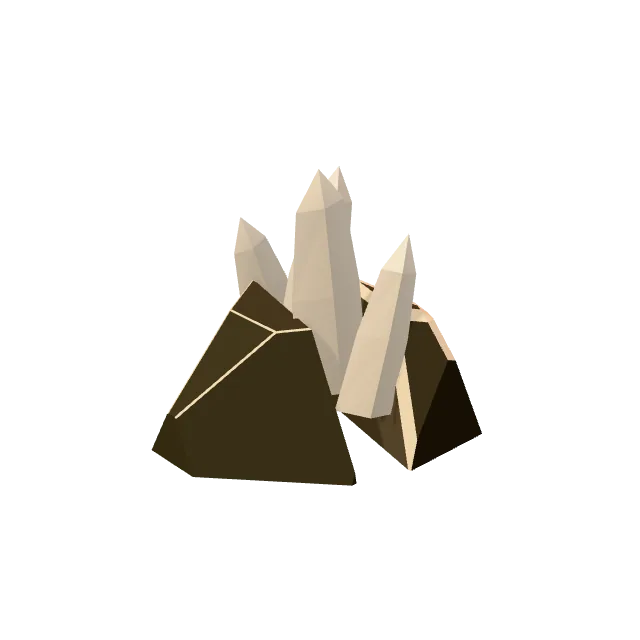 AshstoneSplit basalt with cream quartz blades. Basalt shard, milkvein quartz or fool’s gold. 5 to 6 strikes.
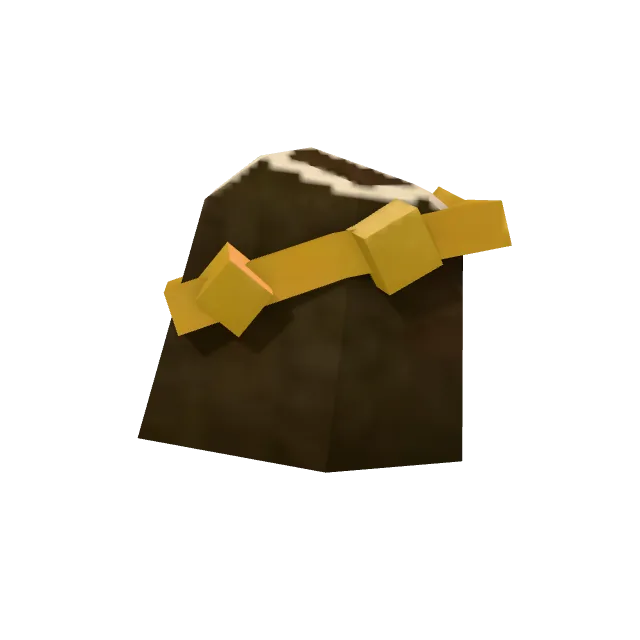 SunveinA slab crossed by a brass seam. Fool’s gold, quartz or the gold nugget. 4 to 5 strikes.
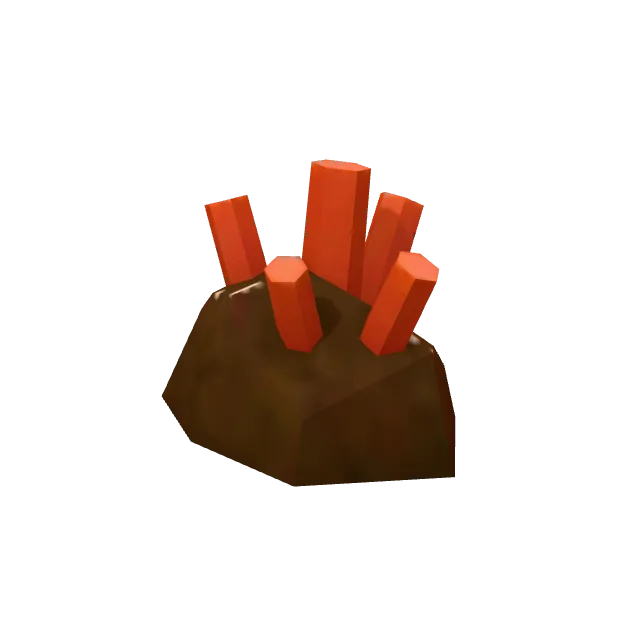 EmberstoneCinder mound with ember-red columns. Ember garnet, emberband agate or emberflow peridot; monazite on Pyrecrown. 3 to 5 strikes.
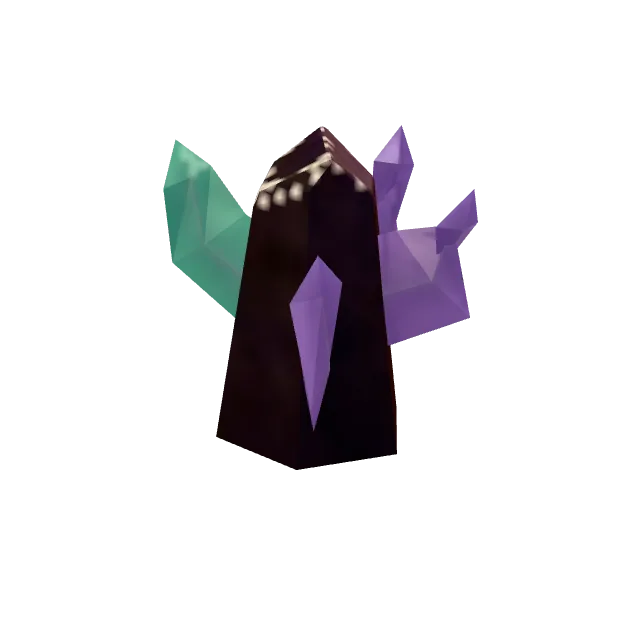 NightglassBroken obsidian spire with a violet edge. Nightglass obsidian or rainbow obsidian. 4 to 5 strikes.
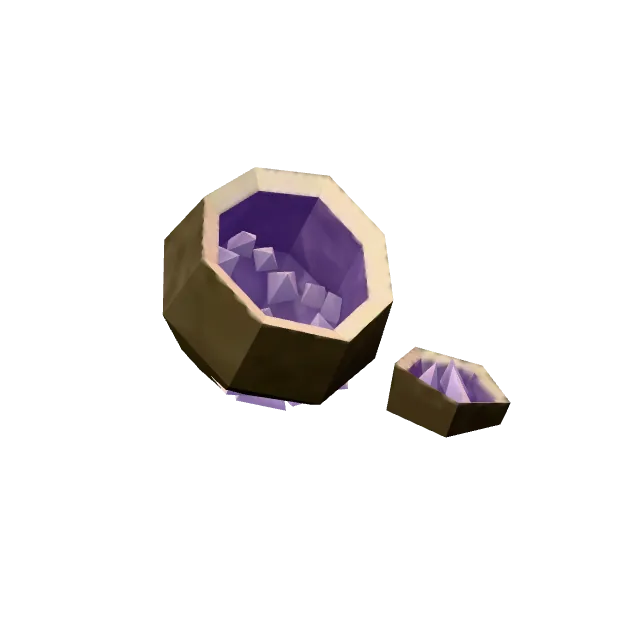 GeodeA split sphere lined with lilac teeth. Quartz, moonlit opal, deepvein geode or starlight amethyst. 3 to 4 strikes.
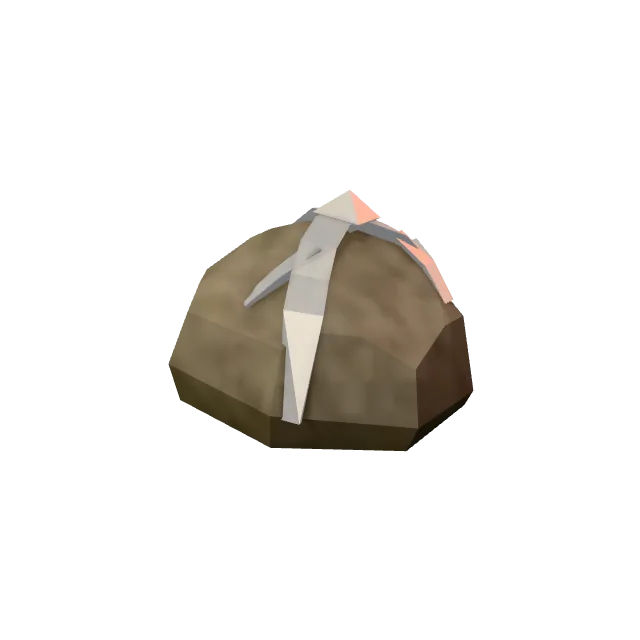 SilverbackA pale dome wrapped in silver wire. Only on Obsidian Reach and Pyrecrown. Quartz and native silver. 3 to 4 strikes.
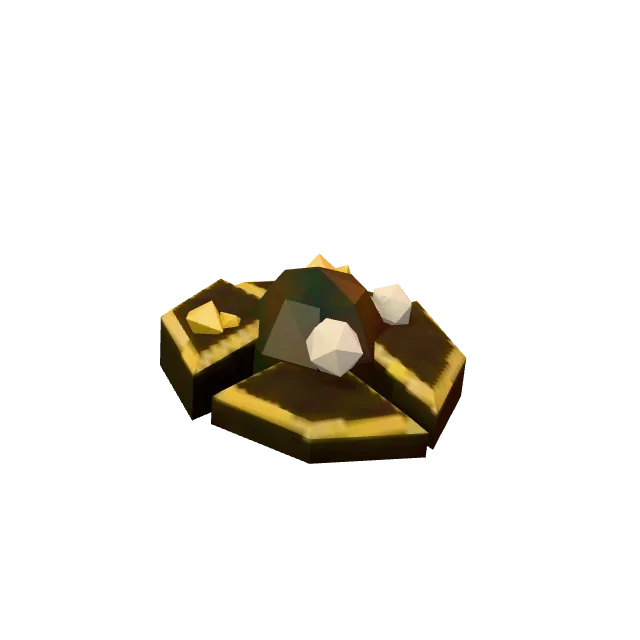 SeepA sulfur-rimmed crust with a black tar dome. Only on Emberhollow. Basalt shards and tar pearls. 4 to 6 strikes.
What a family can give also depends on the claim and your tool: site-locked minerals only turn up on their islands, and a few need a better tool (see minerals). Every family always has a common member, so every dig finds something.
Mining an ore
Mining is a few relaxed swings with one small choice in each: where to hit.
- Start. Walk up to a node and press E, tap the node, or press MINE. You step onto one of its work spots, your first swings land, and the mining panel opens with the ore in front of you.
- Swing. Tap or click the rock, or press E or Space to swing at your pointer. Your tool sets the pace of the swings; there is no clock to beat and no window to catch.
- Hit the shiny spot. One shiny spot, marked with a star, shows on the rock and stays until you hit it; then the next one appears somewhere else. A hit on it counts for more than a hit anywhere else on the rock.
- Watch it shrink. Every swing chips the ore down and cracks it. It comes free after about 10 swings, or about 6 if every swing hits the shiny spot.
- Reveal. The chunk cracks open and shows the mineral, its carats and the sparks it paid.
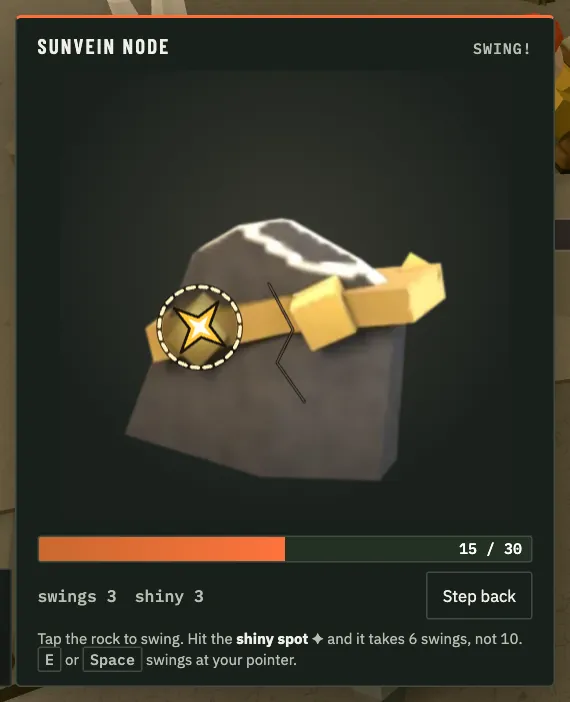
Missing is never a penalty. A swing off the shiny spot is a normal hit and still counts. The more of your swings hit the shiny spot, the cleaner the dig: that nudges your carats toward the heavy end of the mineral’s range and adds up to 6 bonus sparks. It never changes which mineral you find, its rarity or its value.
Left alone, a dig keeps swinging on its own every few seconds, so it always finishes.
Walking away during the first swings cancels the dig and pays nothing. After that your tool finishes the dig on its own while you walk, at the plain pace.
Steady hands and auto-mine
- Steady hands, on the mining console, makes the shiny spot 1.5 times easier to hit, for the same rewards. Only the Clean Strikes tournament leaves it out. The setting is remembered on your device.
- Auto-mine skips the panel and swings ten plain hits for you, about seven seconds a dig, then starts the next dig on its own. It pauses while the tab is hidden or a panel is open, and stops when the node crumbles or nothing is in reach. It never walks for you. Mining by hand and hitting the shiny spot is faster.
- Reduced motion: if your device asks for less motion, the panel keeps animation to a minimum and the ore still shrinks with each swing.
Pickaxe and drills
There are sixteen tools: the old pickaxe you start with, then the Cinderbit drills, up to the vein keeper. Each tier needs lifetime finds and costs sparks; Cinderbit IV also needs $DIGR held in your linked wallet. Better tools reach minerals the ones below cannot and mine a little faster.
Tiers I to IV are open. The higher tiers are released one by one; the game shows them as “Unlocks later” until then.
Cinderbit IV
Tier IV is the first drill with real perks. It needs 160 lifetime finds, 15,000 sparks, and 100,000 $DIGR held in your linked wallet. The hold is checked once, when you upgrade: the tokens are never spent, and selling them later never takes the drill away. The kit panel shows your balance against the 100,000 once the server has checked your wallet.
- Faster swings. About 10% faster than the drill ladder (396 ms a swing instead of 440).
- +10% reward-mineral chance. Gold nugget, native silver, tar pearl and monazite weigh 10% more in every node you dig; the extra comes from the other minerals of the same rock, so a node's odds stay balanced.
- +15% sparks per find. On the find's rolled sparks (not the strike bonus). The find card shows it as the tier bonus.
- $40 a day holder reward limit (tier III: $30).
| Tier | Tool | Lifetime finds | Sparks |
|---|---|---|---|
| I | The old pickaxe | 0 | Free |
| II | Cinderbit II | 25 | 2,500 |
| III | Cinderbit III | 75 | 7,500 |
| IV | Cinderbit IV | 160 | 15,000 |
| V | Cinderbit V | 300 | 25,000 |
| VI | Cinderbit VI | 500 | 50,000 |
| VII | Cinderbit VII | 800 | 75,000 |
| VIII | Cinderbit VIII | 1,200 | 100,000 |
| IX | Cinderbit IX | 1,800 | 200,000 |
| X | Cinderbit X | 2,600 | 500,000 |
| XI | Cinderbit XI | 3,500 | 750,000 |
| XII | Cinderbit XII | 4,500 | 1,000,000 |
| XIII | Cinderbit XIII | 5,700 | 1,500,000 |
| XIV | Cinderbit XIV | 7,000 | 2,000,000 |
| XV | Cinderbit XV | 8,500 | 3,000,000 |
| XVI | The vein keeper | 10,000 | 5,000,000 |
The equipment panel in the game always shows the live requirement for your next tier.
Minerals and the museum
Fifteen minerals have a place in the museum. Fifteen turn up at launch; tar pearl, native silver and monazite are found on their home islands from the first pickaxe. Every find rolls its own carats: most come in near the modest end of the range, and a few kinds have a rare trophy roll far past it. Rarer minerals pay more sparks: 15 to 30 for a common, 23 to 45 uncommon, 38 to 75 rare, 75 to 150 legendary.
| Mineral | Rarity | Where |
|---|---|---|
| Basalt shard | Common | Everywhere |
| Milkvein quartz | Common | Everywhere |
| Fool’s gold | Common | Everywhere |
| Nightglass obsidian | Uncommon | Everywhere |
| Ember garnet | Uncommon | Everywhere |
| Emberflow peridot | Uncommon | Emberhollow and Pyrecrown |
| Tar pearl | Uncommon | Emberhollow, in Seep nodes, from the first pickaxe |
| Moonlit opal | Rare | Everywhere |
| Deepvein geode | Rare | Everywhere, the heaviest finds |
| Emberband agate | Rare | Cinderfield and Obsidian Reach, Drill II and up |
| Starlight amethyst | Rare | Basalt Row and Driftash Flats, Drill III and up |
| Native silver | Rare | Obsidian Reach and Pyrecrown, in Silverback nodes, from the first pickaxe |
| Monazite | Rare | Pyrecrown, in Emberstone nodes, from the first pickaxe |
| Gold nugget | Legendary | Everywhere, in Sunvein nodes |
| Rainbow obsidian | Legendary | Obsidian Reach and Pyrecrown, Drill III and up |
Your museum
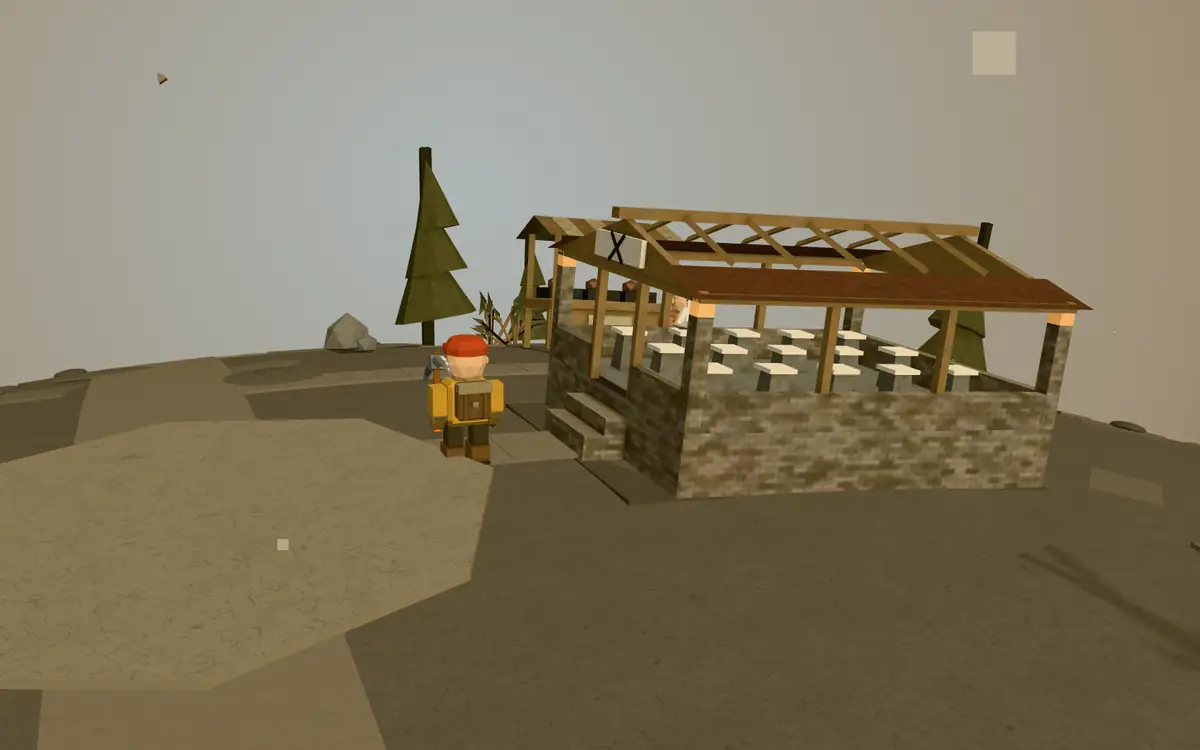
Your museum is the timber pavilion beside the Mosswake square, marked Your museum. Every mineral you discover goes onto one of its pedestals. Press E nearby or use Visit your museum to open it: it shows how many of the fifteen you have found, your best carats for each, and your recent finds. Nothing in it can be traded away.
Islands, claims and signs
Eight islands run from old to young: Mosswake, Fernshadow, Driftash Flats, Basalt Row, Cinderfield, Obsidian Reach, Emberhollow and Pyrecrown, the live crater at the end of the chain. The claims further out are richer.
- Claims are the staked fields where nodes grow, on the islands and out on the mud flats between them.
- Field-station signs stand just outside every claim, facing its island. The sign shows the claim’s name, and its paint band shows how rich the claim is: cream, then yellow, then rust for the richest.
- Day and night are shared by everyone: one full day takes 24 real minutes. At night, lava, lamps and node crystals glow.
- Wildlife: an ash hawk, a mud salamander and a crust crab. Spot one up close for a one-time sighting reward.
The mud buggy
Walkers cannot cross the mud; buggies can. Press B or tap Board a buggy at a depot to drive freely, and B again (or Park here on the flats) to step down. While driving, Choose destination starts a guided ride to another island; other prospectors see you pass, and a ride carries on if you reconnect.
- You cannot mine from the seat: the button reads Park to mine. Park, step down, walk up to the node.
- Ore nodes are solid: a buggy stops at them like a walker does.
- Arriving at an island’s depot for the first time pays 40 sparks, once per island.
Mountains and caves Open
Four mountains stand on the chain, and a cave opens in each of them. On a slope, walkers climb trails and stop where the ground turns to loose scree; buggies keep climbing scree, but nobody passes a cliff.
- Lichen Knoll (Mosswake): a switchback trail to a summit camp with a campfire and benches. The Hollow Adit, a timbered starter tunnel, opens in its foot.
- Steamhead (Fernshadow): white sinter terraces with sulfur rims. A trail curls up from the camp to a steaming pool on top, with seats to sit in the warm water. The Steamvault Grotto opens in its north-west foot; its Opal Vault lies past a seal that needs a tier III tool.
- The Organ Pipes (Basalt Row): column stairs to a terrace, then a scree ramp only a buggy climbs to Pipe Top, a summit claim. The Amethyst Throat opens under it; its Violet Gallery needs a tier V tool.
- The Crown (Pyrecrown): the young volcano, with a glowing crater and lava cracks that brighten after dark. A spiral track winds round it to the Ember Seats; from there a scree ramp takes buggies up to the Ember Shelf, the summit claim round the crater and the richest ground in the game. The Magma Stair lava tube opens in its north foot; its Magma Chamber needs a tier XII tool.
- Caves are walked into: step through the mouth and the view fades inside. Every cave is open to every tool; only the deep galleries behind a seal of hard rock wait for a better one. Ore nodes grow in the chambers and dig their island's own minerals.
Market and wardrobe
Mara keeps the market on Mosswake. Walk up and press E, or press M. It has three tabs: Shop, Wardrobe and Requests. A live 3D mirror lets you try a look on before you take it.
- Earn your favourites: free looks that unlock with your explorer level or by visiting an island.
- Trade your finds: swap spare copies of minerals for a look. Your lifetime finds, journal and museum keep them.
- Fieldwork collection and a little spark shopping: caps, jackets and buggy liveries for sparks.
- Legendary rides and premium costumes: bought only by burning $DIGR (see below).
Costumes are bought by burning $DIGR
The eight legendary costumes and the eight legendary rides cannot be bought with sparks alone. Each one costs a fixed $DIGR burn plus sparks, and both prices are shown on the card. For example, the Big Frank costume is Burn 250,000 $DIGR + 12,000 sparks, and the Wedge EV or the Golden Whale is Burn 1,500,000 $DIGR + 60,000 sparks.
- Sparks are set aside first: when you confirm, the sparks leave your balance and are held for that piece. If the burn does not happen, they come back automatically: when you cancel, when your wallet turns the transfer down, or 30 minutes after you started. Once a burn has been sent, the sparks stay held until it is settled. They are only spent if the piece becomes yours.
- How it works: press the burn button on the card, confirm, and approve one $DIGR transfer in the wallet linked to your prospector. The $DIGR goes to the burn address and the piece is yours as soon as Robinhood Chain confirms it. You pay the small network fee.
- Burned forever: nobody receives the $DIGR, not even the team. Every burn takes $DIGR out of supply.
- Cosmetic only: a burned piece changes how you look, never what you find, how fast you mine or how your buggy drives.
- Safe to interrupt: the game checks your balance before asking your wallet, never charges twice for the same piece, and picks up a burn after a reload or a closed tab, finding it on the chain if needed. If your burn arrives after the checkout lapsed, it still counts: the sparks are set aside again and the piece is yours.
Looks never change what you find or how fast you mine. Tools are the only progression.
Journal and daily goals
- Field journal: a notebook for each of the eight islands, 25 sparks each as you fill them in.
- Starter goals: your first find, meeting the locals, going further out, a chain of stories and, finally, the whole chain. They pay 40 to 500 sparks along the way.
- Daily requests from Mara, refreshed every day: a morning basket of three finds, two finds from a named claim, and a colourful delivery of three different minerals.
- Community goal: the whole chain works toward 75 finds a day. Put in three of your own and collect 75 sparks when the chain gets there.
- Collections: mineral sets that pay a one-time bonus of 100 to 400 sparks when completed.
Tournaments and standings
A tournament opens every two hours and runs for thirty minutes, announced on World radio. The format rotates between Most strikes, Heaviest haul, Rarest haul and Clean Strikes, which ranks the fewest swings per dig. You need at least three finds to be ranked (three digs mined by hand for Clean Strikes), and the top three win 500, 250 and 100 sparks, credited automatically once, a few seconds after the window closes. Equal scores go to whoever reached the score first. A card beside the minimap shows the live standings and your rank.
Clean Strikes counts only digs mined by hand, without steady hands or auto-mine and not walked away from.
Prizes today are sparks, the in-game currency. No tournament pays real assets or $DIGR yet. A real-asset prize (CLSK) is planned for later and will be announced here when it is live.
The standings (L, or the homepage) cover Most finds, Heaviest find and Sparks, each for all time and for this week. The week resets every Monday at 00:00 UTC. A board shows a display name and a number, nothing else.
Fair play and proofs
- Sealed before you swing. When a dig starts, the server commits to a secret random seed by publishing its fingerprint. The mineral, its carats and its sparks all come from that seed, so how you swing can never change what the rock holds.
- Replayable. After a dig settles the seed is revealed. The proof for your own dig (
/api/crypto/proof?id=with the dig id, while signed in as you) contains the commitment, the seed, the shiny spots and your recorded swings, so the result can be recomputed from scratch. - Machine-driven play is watched, not banned. Swing statistics are recorded for review; they never block play, and today they do not remove anyone from a tournament or from rewards.
- Server authority. Your position, finds and sparks are decided on the server; the game only sends where you want to go and where you swing.
What is coming In development
- Glassback Ridge. The fifth mountain: a knife ridge of black glass over Obsidian Reach, with a buggy track to the Glass Shelf summit claim (see mountains and caves for the four that are open).
- Higher tools. Tiers V to XVI, released one by one.
- Two more caves. The Tar Seep, a sinkhole of oily black pits on Emberhollow, and the Silverglass Galleries, wire silver in black glass under Glassback Ridge.
- Biomes. Every island becomes its own place: sinter terraces, black-sand dunes, basalt columns, scoria cones, obsidian glass, sulfur and tar, fresh lava crust.
World radio and accounts